Species guide
Blue whale
Balaenoptera musculus
At a glance
Conservation, taxonomy and Madeira records reviewed . Review sources.
- Global IUCN conservation status
- Endangered — assessment published .
2018 assessment; the linked errata version was published in 2019.
Global extinction risk is separate from sighting frequency in Madeira.
- Identification
- Huge, grey/bluish mottled body with very big head (one fourth of total body length)
- Pale blue/grey or white underside.
- Size
- Maximum length: 24 to 33.6 m, depending on the subspecies
- Recorded occurrence in Madeira
- Reported on local trips, including September 2025.
- Madeira records and season
- No dependable seasonal window established by the cited records.
Identification and size summarize profile notes updated . Local records are past observations, not a prediction of sightings.
Read the identification notes ↓- Taxonomic authority
- (Linnaeus, 1758)
- Family
- Balaenopteridae
- Cetacean group
- Mysticeti
Sightings in Madeira
The 2012 Madeira checklist documents blue-whale sightings; isolated records do not establish a migration season. Historical evidence.
Our September 2025 trip report lists this species. This is an operator observation, not a population estimate.
No dependable seasonal window established by the cited records. The months in individual reports should not be treated as the limits of a season.
ID characteristics
Huge, grey/bluish mottled body with very big head (one fourth of total body length)
Pale blue/grey or white underside.
Very small dorsal fin set well back (about three quarters) along its body
Surface behaviour
Settle or slowly swim without exposing rear body.
Some individuals are easy to approach.
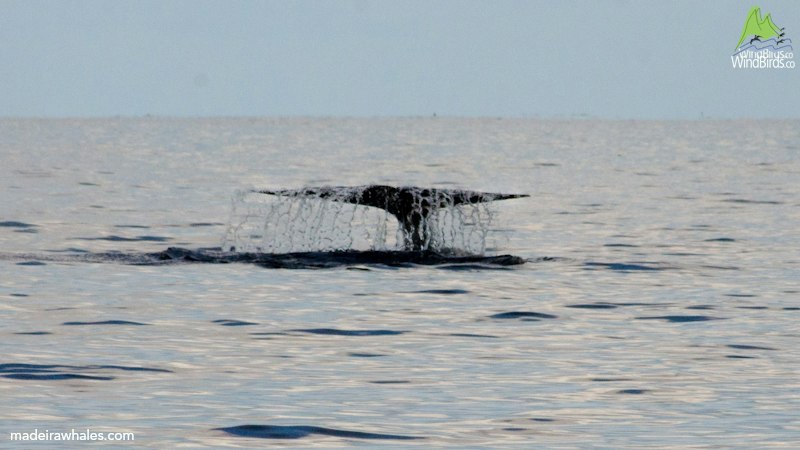
May show flukes on diving
Distribution
All over the world, though separate populations in North Pacific, North Atlantic, Indian and Southern Oceans.
Worldwide, mainly in cold waters and open ocean
Social
1 or 2 individuals together
Diet
Krill and other crustaceans
Biometrics
Max length: 24 to 33.6 m, depending on the subspecies
Adult weight: 100 to 120 ton
Blow
Upright and columnar up to 12 meters tall. Regular blows every 10 to 20 seconds for about 2 to 6 minutes before diving
Common names in other languages
- Portuguese: Baleia azul
- German: Blauwal
- French: Baleine bleue, Rorqual bleu
- Spanish: Rorcual azul, Ballena azul
- Italian: Balenottera azzurra
- Dutch: Blauwe vinvis
- Polish: Płetwal błękitny
- Swedish: Blåval
- Danish: Blåhval
- Norwegian: Blåkval, Blåhval
Other English names
Sulphur-bottom Whale
Names vary by language and region. This list is not exhaustive. Multilingual name records.
Review sources
Conservation, taxonomy, local occurrence and seasonality checked on . The assessment publication year is separate from this editorial review date. Identification, size, other biology notes and multilingual aliases are outside this review unless a specific source is cited alongside them.
- IUCN Red List: Balaenoptera musculus — global species assessment, published 2018.
- Society for Marine Mammalogy: species and subspecies list (April 2026) — Scientific names, authorities, families and English names. Mysticeti and Odontoceti are treated as unranked groups.
- IUCN SSC Cetacean Specialist Group: Red List status of cetaceans — Global species categories cross-checked against the specialist group's overview, updated October 2025. Regional and subpopulation assessments are separate.
- IUCN Cetacean Specialist Group: November 2018 assessments — Global assessment publication years and category changes. A category change need not indicate a recent population change.
- Freitas et al. (2012): New records of cetacean species for Madeira Archipelago with an updated checklist — Table 1 and species accounts distinguish sightings, catches and strandings. Record totals and last-record dates describe evidence available through December 2012.
The linked trip reports document operator observations. They do not independently confirm every identification or measure population size, abundance or the probability of a sighting.