Species guide
Rough-toothed dolphin
Steno bredanensis
At a glance
Conservation, taxonomy and Madeira records reviewed . Review sources.
- Global IUCN conservation status
- Least Concern — assessment published .
2019 assessment; the linked errata version was published in 2020.
Global extinction risk is separate from sighting frequency in Madeira.
- Identification
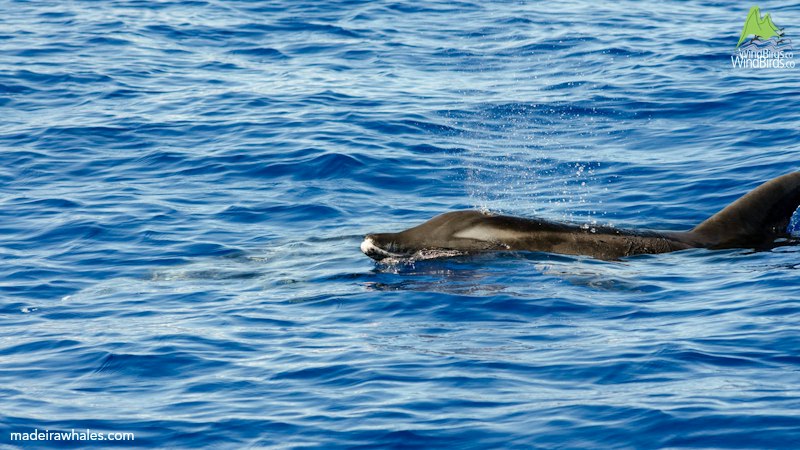
- Dark, narrow cape, sometimes not easily distinguished from its grey bluish flanks. White to pinkish underbody
- Conical head shape and long, dark, reptilian body
- Size
- Maximum length: 2.65 m
- Recorded occurrence in Madeira
- Reported on local trips, including September 2026.
- Madeira records and season
- Warm-water visitor, especially in summer; exact arrival and departure months vary.
Identification and size summarize profile notes updated . Local records are past observations, not a prediction of sightings.
Read the identification notes ↓- Taxonomic authority
- (Lesson, 1828)
- Family
- Delphinidae
- Cetacean group
- Odontoceti
Sightings in Madeira
Our September 2026 trip report lists this species. This is an operator observation, not a population estimate.
Warm-water visitor, especially in summer; exact arrival and departure months vary. Madeira habitat research. Modelled habitat suitability describes environmental conditions, not the probability of seeing an animal on a trip.
ID characteristics
Dark, narrow cape, sometimes not easily distinguished from its grey bluish flanks. White to pinkish underbody
Conical head shape and long, dark, reptilian body
Falcate to triangular dorsal fin, highly erect
Long beak smoothly prolonged from forehead with conspicuous white or pink mouth line, lower jaw and tip
Surface behaviour
Fast swimming, sometimes with tip of beak and chin out of the water
Often several individuals swim shoulder to shoulder, making a line (phalanx)
Distribution
Worldwide between parallels 40º North and 40º South
Deep tropical, subtropical and warm temperate waters around the world
Social
In small groups between 5 to 20 individuals
Diet
Fish and squid
Biometrics
Max length: 2.65 m
Adult weight: 100 to 150 kg
Common names in other languages
- Portuguese: Golfinho-de-dentes-rugosos, Caldeirão
- German: Rauzahndelfin
- French: Dauphin à bec étroit, Sténo
- Spanish: Delfín de diente rugoso, Delfín de pico largo, Delfín de hocico estrecho
- Italian: Steno
- Dutch: Snaveldolfijn
- Polish: Delfin długonosy
- Swedish: Näbbdelfin
- Danish: Rutandet delfin
Names vary by language and region. This list is not exhaustive. Multilingual name records.
Review sources
Conservation, taxonomy, local occurrence and seasonality checked on . The assessment publication year is separate from this editorial review date. Identification, size, other biology notes and multilingual aliases are outside this review unless a specific source is cited alongside them.
- IUCN Red List: Steno bredanensis — global species assessment, published 2019.
- Society for Marine Mammalogy: species and subspecies list (April 2026) — Scientific names, authorities, families and English names. Mysticeti and Odontoceti are treated as unranked groups.
- IUCN SSC Cetacean Specialist Group: Red List status of cetaceans — Global species categories cross-checked against the specialist group's overview, updated October 2025. Regional and subpopulation assessments are separate.
- IUCN Cetacean Specialist Group: July 2019 assessments — Global rough-toothed dolphin and melon-headed whale assessments.
- Freitas et al. (2012): New records of cetacean species for Madeira Archipelago with an updated checklist — Table 1 and species accounts distinguish sightings, catches and strandings. Record totals and last-record dates describe evidence available through December 2012.
- Fernandez et al. (2021): Modeling fine-scale cetacean distributions in Madeira — Models based on observations from 2003–2018. Seasonal habitat suitability is not a forecast of sightings or proof that animals are absent in other months.
The linked trip reports document operator observations. They do not independently confirm every identification or measure population size, abundance or the probability of a sighting.