Species guide
Short-beaked common dolphin
Delphinus delphis
At a glance
Conservation, taxonomy and Madeira records reviewed . Review sources.
- Global IUCN conservation status
- Least Concern — assessment published .
Global extinction risk is separate from sighting frequency in Madeira.
- Identification
- Dark cape making a “V” below the dorsal fin with conspicuous yellowish or tan thoracic panel.
- Black spot around the eye and stripe from middle lower jaw to flipper
- Size
- Maximum length: 2.7 m
- Recorded occurrence in Madeira
- Reported on local trips, including July 2026.
- Madeira records and season
- Winter/spring tendency; sightings also occur in other months.
Identification and size summarize profile notes updated . Local records are past observations, not a prediction of sightings.
Read the identification notes ↓- Taxonomic authority
- Linnaeus, 1758
- Family
- Delphinidae
- Cetacean group
- Odontoceti
The Society for Marine Mammalogy lists Delphinus delphis as the common dolphin. 'Short-beaked common dolphin' remains a descriptive name in this guide and its historical reports. The global assessment includes the forms grouped within D. delphis. Taxonomy source.
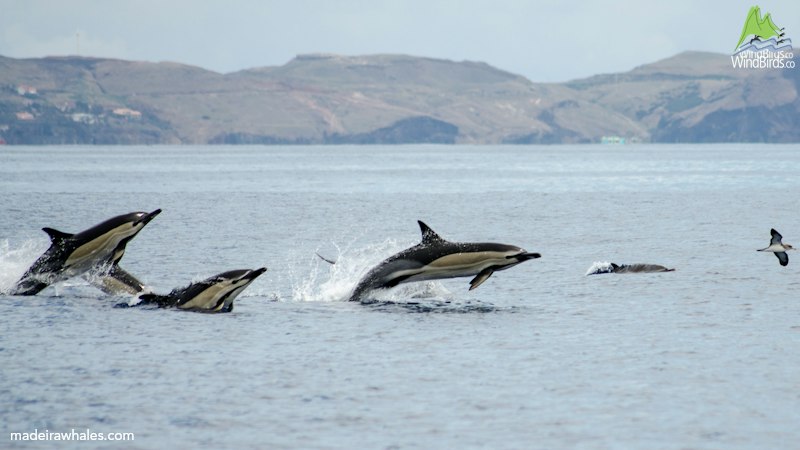
Sightings in Madeira
Our July 2026 trip report lists this species. This is an operator observation, not a population estimate.
Winter/spring tendency; sightings also occur in other months. Madeira habitat research. Modelled habitat suitability describes environmental conditions, not the probability of seeing an animal on a trip.
ID characteristics
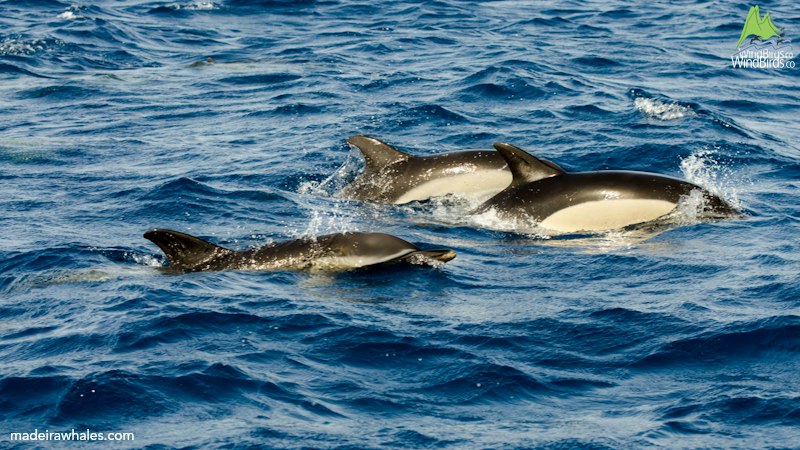
Dark cape making a “V” below the dorsal fin with conspicuous yellowish or tan thoracic panel.
Black spot around the eye and stripe from middle lower jaw to flipper
Tall, falcate and pointed dorsal fin
Medium, chunky beak with pale base
Surface behaviour
Fast swimmer and acrobat
Highly vocal, sometimes can be heard above the surface
Can associate with other mammals or seabirds’ feeding frenzies
Distribution
Worldwide between the 40º parallels though it can reach 60º North in the Atlantic and 50º South in the Pacific.
Warm temperate, subtropical and tropical waters around the world
Social
Groups between 10 to a few hundred
Diet
Fish and squid
Biometrics
Max length: 2.7 m
Adult weight: 70 to 110 kg
Common names in other languages
- Portuguese: Golfinho comum
- German: Gemeiner Delfin, Gewöhnlicher Delfin
- French: Dauphin commun à bec court
- Spanish: Delfín común de hocico corto
- Italian: Delfino comune
- Dutch: Gewone dolfijn
- Polish: Delfin zwyczajny, Delfin pospolity, Delfin zwyczajny krótkopyski
- Swedish: Sadeldelfin, Kortnosad vanlig delfin, Springare
- Danish: Almindelig delfin
- Norwegian: Gulflankedelfin, Vanleg delfin
Names vary by language and region. This list is not exhaustive. Multilingual name records.
Review sources
Conservation, taxonomy, local occurrence and seasonality checked on . The assessment publication year is separate from this editorial review date. Identification, size, other biology notes and multilingual aliases are outside this review unless a specific source is cited alongside them.
- IUCN Red List: Delphinus delphis — global species assessment, published 2021.
- Society for Marine Mammalogy: species and subspecies list (April 2026) — Scientific names, authorities, families and English names. Mysticeti and Odontoceti are treated as unranked groups.
- IUCN SSC Cetacean Specialist Group: Red List status of cetaceans — Global species categories cross-checked against the specialist group's overview, updated October 2025. Regional and subpopulation assessments are separate.
- IUCN Cetacean Specialist Group: March 2021 assessments — Global common dolphin and northern bottlenose whale assessments. The common dolphin assessment combines the forms included in Delphinus delphis.
- Freitas et al. (2012): New records of cetacean species for Madeira Archipelago with an updated checklist — Table 1 and species accounts distinguish sightings, catches and strandings. Record totals and last-record dates describe evidence available through December 2012.
- Fernandez et al. (2021): Modeling fine-scale cetacean distributions in Madeira — Models based on observations from 2003–2018. Seasonal habitat suitability is not a forecast of sightings or proof that animals are absent in other months.
- Alves et al. (2018): Long-term cetacean occurrence patterns in Madeira — Eleven years of whale-watching observations; useful for occurrence, with limits from uneven survey coverage and detection.
The linked trip reports document operator observations. They do not independently confirm every identification or measure population size, abundance or the probability of a sighting.