Species guide
Short-finned pilot whale
Globicephala macrorhynchus
At a glance
Conservation, taxonomy and Madeira records reviewed . Review sources.
- Global IUCN conservation status
- Least Concern — assessment published .
Global extinction risk is separate from sighting frequency in Madeira.
- Identification
- Stocky but elongated, medium-sized, blackish body with white anchor-shaped patch on chest
- Rather long flippers (not as long as on Long-finned Pilot whales), sickled-shaped.
- Size
- Maximum length: 7.2 m
- Recorded occurrence in Madeira
- Reported on local trips, including September 2026.
- Madeira records and season
- Recorded throughout the year; seasonal use varies.
Identification and size summarize profile notes updated . Local records are past observations, not a prediction of sightings.
Read the identification notes ↓- Taxonomic authority
- Gray, 1846
- Family
- Delphinidae
- Cetacean group
- Odontoceti
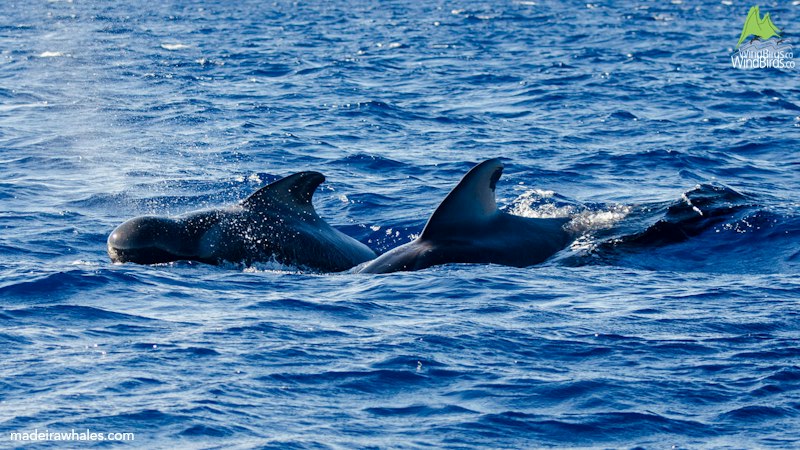
Sightings in Madeira
Our September 2026 trip report lists this species. This is an operator observation, not a population estimate.
Recorded throughout the year; seasonal use varies. Madeira habitat research. Modelled habitat suitability describes environmental conditions, not the probability of seeing an animal on a trip.
ID characteristics
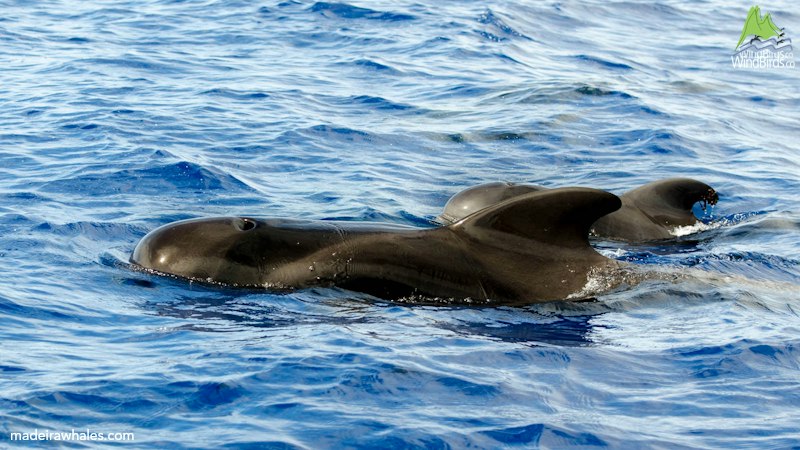
Stocky but elongated, medium-sized, blackish body with white anchor-shaped patch on chest
Rather long flippers (not as long as on Long-finned Pilot whales), sickled-shaped.
Rounded, bulbous forehead with no or tiny beak
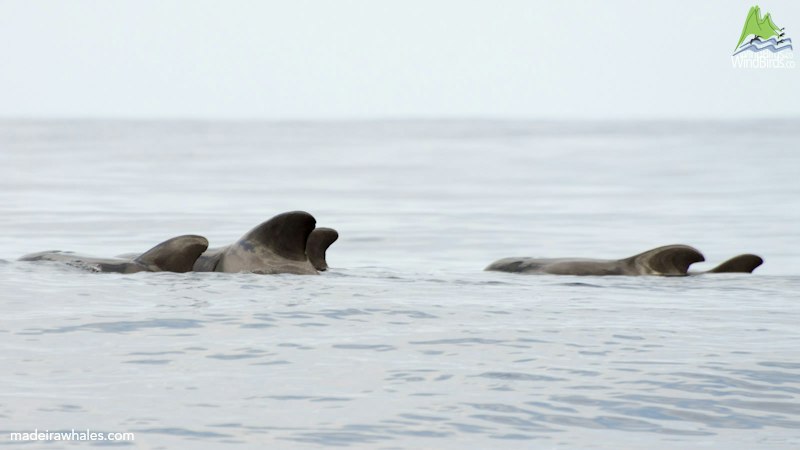
Dorsal fin is falcate, sweeping backwards but set forward on body, though very variable with age and sex
Surface behaviour
Slow swimmer at surface, often motionless
Often lobtails and spy-hops
Distribution
Worldwide between parallels 45º North and 40º South
Mid-latitude oceans with tropical and warm temperate seas
Social
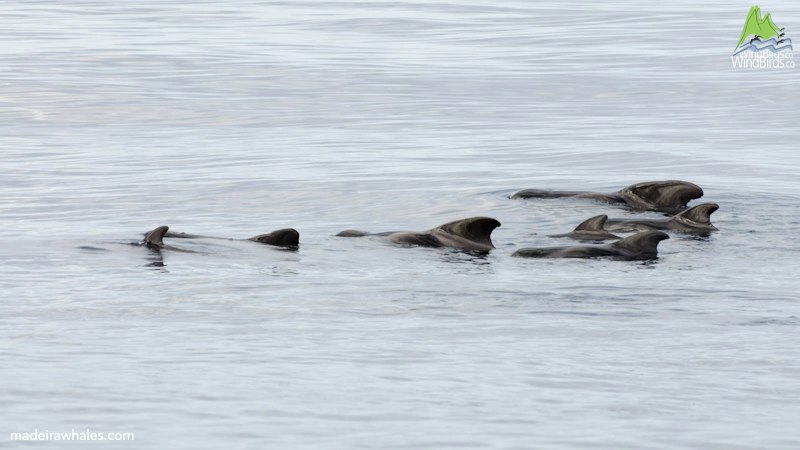
In groups from 10 to 30 individuals or more
Diet
Squid and fish
Biometrics
Max length: 7.2 m
Adult weight: 1 to 4 ton
Blow
Bushy shaped and low
Common names in other languages
- Portuguese: Baleia piloto de aleta curta, Baleia piloto de peitorais curtas, Boca de panela, Boto
- German: Kurzflossen-Grindwal, Indischer Grindwal
- French: Globicéphale tropical, Baleine pilote
- Spanish: Calderón tropical, Calderón de aleta corta
- Italian: Globicefalo di Gray
- Dutch: Indische griend, Kortflippergriend
- Polish: Grindwal krótkopłetwy, Pilot
- Swedish: Kortfenad grindval, Indiska oceanens pilotval
- Danish: Kortfinnet grindehval
- Norwegian: Kortfinnegrindval
Names vary by language and region. This list is not exhaustive. Danish name: Dansk Zoologisk Selskab, Habitat 4 (2011). Multilingual name records.
Review sources
Conservation, taxonomy, local occurrence and seasonality checked on . The assessment publication year is separate from this editorial review date. Identification, size, other biology notes and multilingual aliases are outside this review unless a specific source is cited alongside them.
- IUCN Red List: Globicephala macrorhynchus — global species assessment, published 2018.
- Society for Marine Mammalogy: species and subspecies list (April 2026) — Scientific names, authorities, families and English names. Mysticeti and Odontoceti are treated as unranked groups.
- IUCN SSC Cetacean Specialist Group: Red List status of cetaceans — Global species categories cross-checked against the specialist group's overview, updated October 2025. Regional and subpopulation assessments are separate.
- IUCN Cetacean Specialist Group: November 2018 assessments — Global assessment publication years and category changes. A category change need not indicate a recent population change.
- Freitas et al. (2012): New records of cetacean species for Madeira Archipelago with an updated checklist — Table 1 and species accounts distinguish sightings, catches and strandings. Record totals and last-record dates describe evidence available through December 2012.
- Fernandez et al. (2021): Modeling fine-scale cetacean distributions in Madeira — Models based on observations from 2003–2018. Seasonal habitat suitability is not a forecast of sightings or proof that animals are absent in other months.
The linked trip reports document operator observations. They do not independently confirm every identification or measure population size, abundance or the probability of a sighting.