Species guide
Sperm whale
Physeter macrocephalus
At a glance
Conservation, taxonomy and Madeira records reviewed . Review sources.
- Global IUCN conservation status
- Vulnerable — assessment published .
Amended in 2019 from the 2008 assessment; this is not a 2019 reassessment of the population.
Global extinction risk is separate from sighting frequency in Madeira.
- Identification
- Very long, dark grey body with wrinkled skin and a low, triangular or rounded hump instead of dorsal fin.
- Squarish head with single slit-like blowhole on left side near the forehead.
- Size
- Maximum length: 18.3 m
- Recorded occurrence in Madeira
- Reported on local trips, including September 2026.
- Madeira records and season
- Present throughout the year; habitat models suggest greater suitability in summer/autumn.
Identification and size summarize profile notes updated . Local records are past observations, not a prediction of sightings.
Read the identification notes ↓- Taxonomic authority
- Linnaeus, 1758
- Family
- Physeteridae
- Cetacean group
- Odontoceti
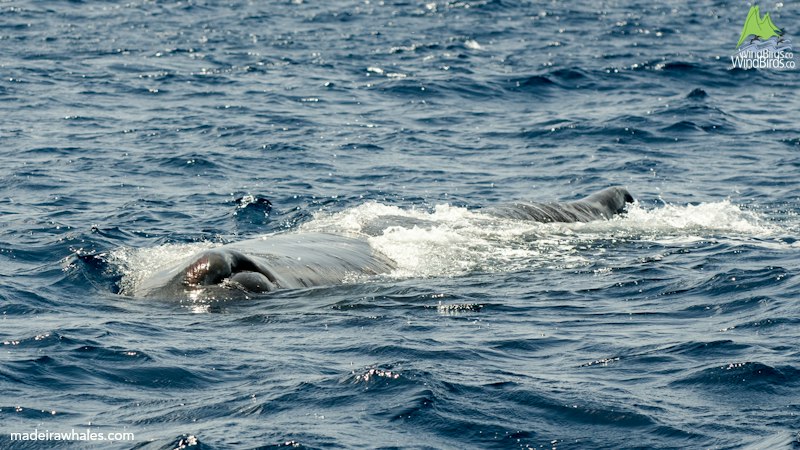
Sightings in Madeira
Our September 2026 trip report lists this species. This is an operator observation, not a population estimate.
Present throughout the year; habitat models suggest greater suitability in summer/autumn. Madeira habitat research. Modelled habitat suitability describes environmental conditions, not the probability of seeing an animal on a trip.
ID characteristics
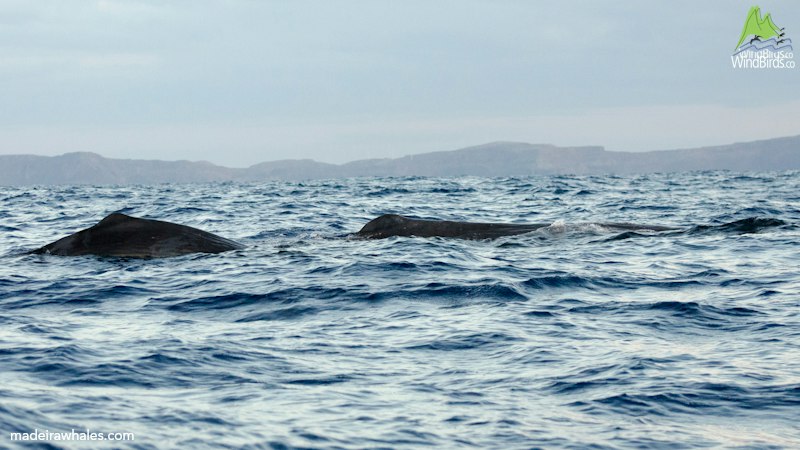
Very long, dark grey body with wrinkled skin and a low, triangular or rounded hump instead of dorsal fin.
Squarish head with single slit-like blowhole on left side near the forehead.
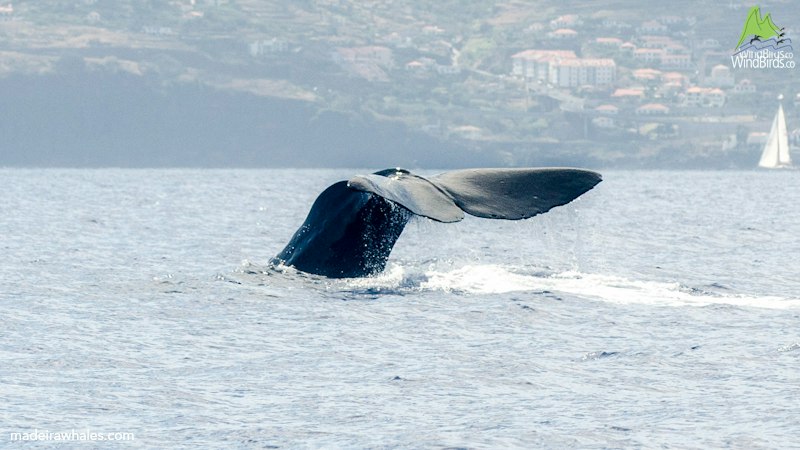
Broad triangular flukes.
Surface behaviour
When surfacing usually remains almost motionless but may swim leisurely. Normally it is visible at surface between 10 and 15 minutes while its dives may last in average 45 minutes. Flukes raised on diving. Frequently breaches and lobtails.
Distribution
Widely distributed between parallels 65º North and 70º South.
Worldwide in deep waters avoiding polar seas
Social
Alone or in group up to 50 individuals
Diet
Mainly squid but sometimes fish.
Biometrics
Max length: 18.3 m
Adult weight: 20 to 50 ton
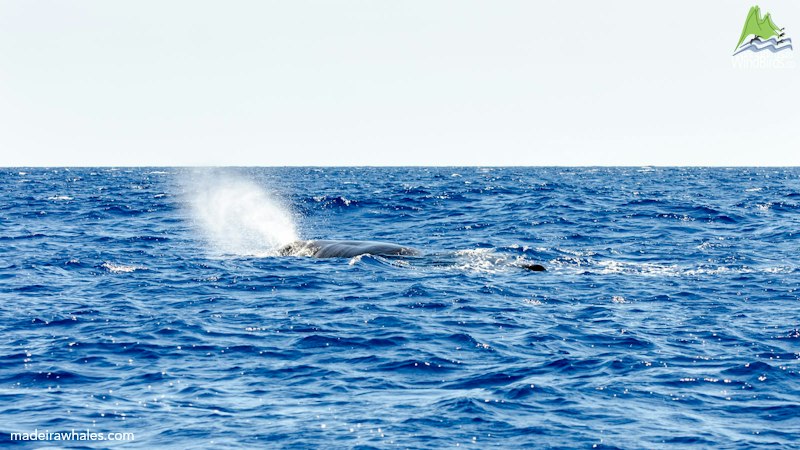
Blow
Diagonal blow, bush shaped and projected forward at low angle. Normally about 2 m but can reach 5 m.
Common names in other languages
- Portuguese: Cachalote
- German: Pottwal
- French: Cachalot
- Spanish: Cachalote, Ballena de Esperma
- Italian: Capodoglio
- Dutch: Potvis
- Polish: Kaszalot, Potwal, Potwal olbrotowiec
- Swedish: Kaskelot
- Danish: Kaskelothval
- Norwegian: Spermkval, Spermhval
Other English names
Cachalot, Pot Whale, Spermacet Whale
Names vary by language and region. This list is not exhaustive. Multilingual name records.
Review sources
Conservation, taxonomy, local occurrence and seasonality checked on . The assessment publication year is separate from this editorial review date. Identification, size, other biology notes and multilingual aliases are outside this review unless a specific source is cited alongside them.
- IUCN Red List: Physeter macrocephalus — global species assessment, published 2019.
- Society for Marine Mammalogy: species and subspecies list (April 2026) — Scientific names, authorities, families and English names. Mysticeti and Odontoceti are treated as unranked groups.
- IUCN SSC Cetacean Specialist Group: Red List status of cetaceans — Global species categories cross-checked against the specialist group's overview, updated October 2025. Regional and subpopulation assessments are separate.
- IUCN Red List: sperm whale, 2008 assessment amended in 2019 — The 2019 publication is an amendment of the 2008 assessment, not a new assessment of population status.
- Freitas et al. (2012): New records of cetacean species for Madeira Archipelago with an updated checklist — Table 1 and species accounts distinguish sightings, catches and strandings. Record totals and last-record dates describe evidence available through December 2012.
- Fernandez et al. (2021): Modeling fine-scale cetacean distributions in Madeira — Models based on observations from 2003–2018. Seasonal habitat suitability is not a forecast of sightings or proof that animals are absent in other months.
The linked trip reports document operator observations. They do not independently confirm every identification or measure population size, abundance or the probability of a sighting.